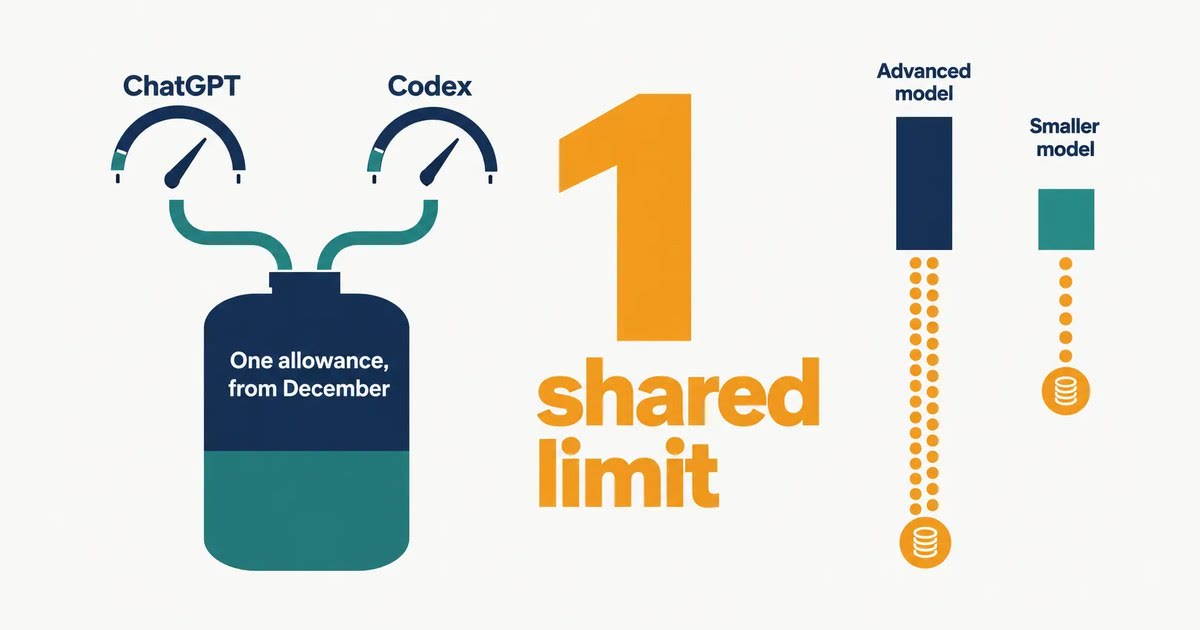
OpenAI plans to combine the usage allowances for ChatGPT and its coding tool Codex starting in December 2026, according to an updated help center article titled "Understanding ChatGPT and Codex usage limits." The change applies to Plus, Pro and Business subscribers, FourWeekMBA and TokenPost reported on October 31, 2026. (FourWeekMBA (opens in a new tab); TokenPost (opens in a new tab))
OpenAI has not named an exact day in December. CellCog, which tracked the help page, said the update appeared on October 31 and that the page does not mention the Free, Go or Enterprise plans. (FourWeekMBA (opens in a new tab); CellCog (opens in a new tab))
How the shared allowance works
Usage will be measured in tokens, counting both the input a user sends and the output a model generates. OpenAI says advanced models and more complex tasks generally use more of the allowance, so the same plan can last a very different amount of time depending on how it is used. (TokenPost (opens in a new tab); Superpower Daily (opens in a new tab))
One category stays outside the pool. OpenAI's help text says "Instant chat will not draw from your usage," according to TokenPost. FourWeekMBA noted that some posts on X described Instant as unlimited, a claim it said OpenAI's text does not make. (FourWeekMBA (opens in a new tab); TokenPost (opens in a new tab))
Subscribers will be able to see their combined remaining usage and reset times under Settings. When they reach the limit, they can wait for a reset, upgrade their plan or buy credits for eligible features. OpenAI said it expects most users will not have to wait for resets more often than they do today. (TokenPost (opens in a new tab); Superpower Daily (opens in a new tab))
Part of a broader merge
OpenAI links the change to bringing the agent features of ChatGPT Work into the main ChatGPT experience. CellCog reported that for Plus and Pro, Codex, ChatGPT Work, Excel and PowerPoint already share a single agentic allowance, so the December change extends that pooling to regular chat with advanced models. (FourWeekMBA (opens in a new tab); CellCog (opens in a new tab))
OpenAI's current estimates give a sense of how much model choice matters. For a Plus subscriber in a five-hour window, its Work and Codex help page lists roughly 5 to 45 messages with GPT-6 Astra, 15 to 160 with GPT-6.1 Sol and 350 to 3,000 with GPT-6 Luna, FourWeekMBA reported. OpenAI describes these as estimates, not guaranteed counts. The Pro 100, Pro 200 and Pro 500 plans currently have no five-hour limit in Work and Codex. (FourWeekMBA (opens in a new tab))
Several details are still missing. OpenAI has not published the size of each plan's allowance, how chat and Codex tokens convert into it, or how Business seat pricing might change, according to CellCog and Superpower Daily. (Superpower Daily (opens in a new tab); CellCog (opens in a new tab))
The announcement follows OpenAI's October 29 decision to double Work and Codex usage on its Pro 100 and Pro 500 plans and cancel a planned cut to Pro 200, and comes a day after Anthropic said it was removing the five-hour limit for verified accounts on its $200 Claude Ultra plan. (FourWeekMBA (opens in a new tab); CellCog (opens in a new tab))
A single pool is simpler to read, but it also means heavy Codex sessions and long chats with advanced models now compete for the same budget. For people who use both tools every day, the real effect depends on numbers OpenAI has not yet shared.