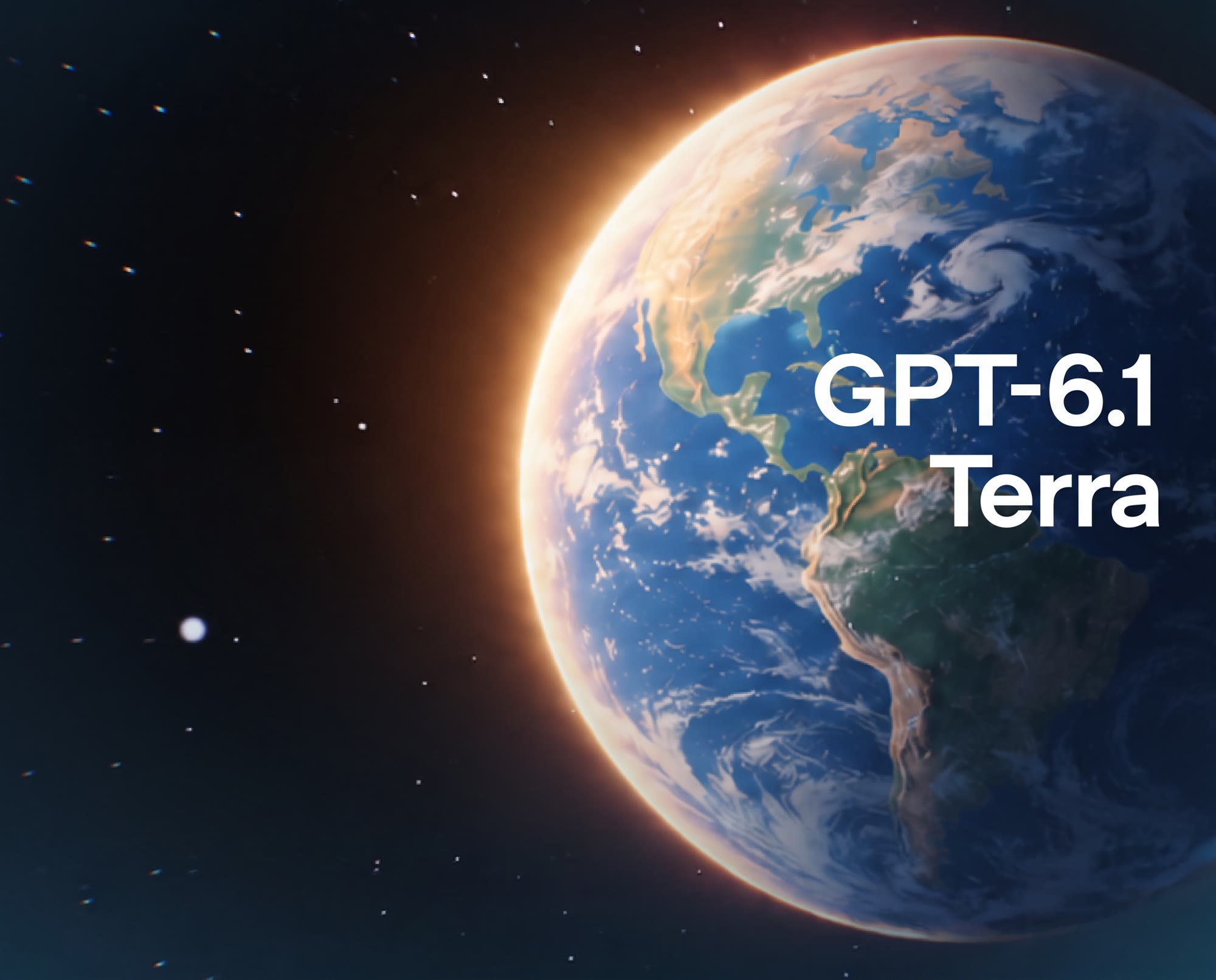
OpenAI released GPT-6.1 Terra on October 26, 2026. In its announcement on X, the company described the model as delivering fast and capable computer use at a lower price, saying it can understand what is on screen, take action across apps and write more naturally. (OpenAI on X (opens in a new tab); 9to5Mac (opens in a new tab))
Terra sits in the middle of OpenAI's lineup. 9to5Mac lists the four model classes from lowest to highest price as Luna, Terra, Sol and Astra, and notes that when OpenAI released the GPT-6 versions of Sol and Luna in September, Terra was left on GPT-5.6. The new release moves it to GPT-6.1, about four weeks after GPT-6.1 Sol, according to iThinkDifferent. (9to5Mac (opens in a new tab); iThinkDifferent (opens in a new tab))
Price and availability
The standard API price is $1 per million input tokens, $5 per million output tokens and $0.05 per million cached input tokens, half of GPT-6.1 Sol's $2 and $10, iThinkDifferent and Nerdschalk reported. OpenAI says the model costs 50 percent less than GPT-5.6 Terra, which it replaces. Batch and Flex processing cost half the standard rate, according to Nerdschalk. (9to5Mac (opens in a new tab); iThinkDifferent (opens in a new tab); Nerdschalk (opens in a new tab))
The model is rolling out in ChatGPT Work and Codex for Plus, Pro, Enterprise and Edu users. Developers can call it as gpt-6.1-terra through the Responses, Chat Completions and Batch interfaces, but not on the API free tier. Nerdschalk reported a context window of 1,050,000 tokens in the API and 500,000 tokens in Codex, with a knowledge cutoff of June 1, 2026. (iThinkDifferent (opens in a new tab); Nerdschalk (opens in a new tab))
What OpenAI claims it can do
According to results OpenAI reported and iThinkDifferent summarized, Terra completes computer use tasks more than three times faster than GPT-6 Astra and GPT-6.1 Sol. On the Agents' Last Exam benchmark at maximum effort, OpenAI says it is more than three times as token efficient as Anthropic's Claude Opus 5.5 at one fourth the cost per token. On Terminal-Bench 4.0 at maximum effort it solved 50.3 percent of tasks, compared with 21.5 percent for GPT-5.6 Terra, although OpenAI still points to Sol and Astra for the hardest coding work. (iThinkDifferent (opens in a new tab))
OpenAI also reported fewer errors on an internal set of prompts designed to trigger mistakes. At low reasoning effort the error rate fell from 53.6 percent with GPT-5.6 Terra to 16.7 percent, and at maximum effort it fell by 18 percentage points to 4.3 percent, close to GPT-6 Astra and GPT-6.1 Sol, 9to5Mac reported. The model reaches the Critical level for cybersecurity under OpenAI's Preparedness Framework and keeps protections built for GPT-6 Astra, iThinkDifferent said. (9to5Mac (opens in a new tab); iThinkDifferent (opens in a new tab))
The release pushes computer use down into OpenAI's cheaper tier. Agents that read screens and click through software run long chains of steps, so price per token and speed matter more than peak capability, and that is exactly where Terra is positioned. All of the performance figures come from OpenAI's own testing, so independent results will matter.